
Natural plastic - the NaKu plastic cross
The different definitions for plastics using the NaKu plastic cross
The NaKu plastic cross:
The term "bioplastic" is very broad. There is no uniform definition yet. All products that either contain a renewable component, i.e., are made from renewable raw materials, or are biodegradable can be called bioplastics.
This means that even PVC with only 20% renewable content can be called a bioplastic. Therefore, there are various forms of bioplastics with different properties – the NaKu plastics cross provides an overview (see graphic).
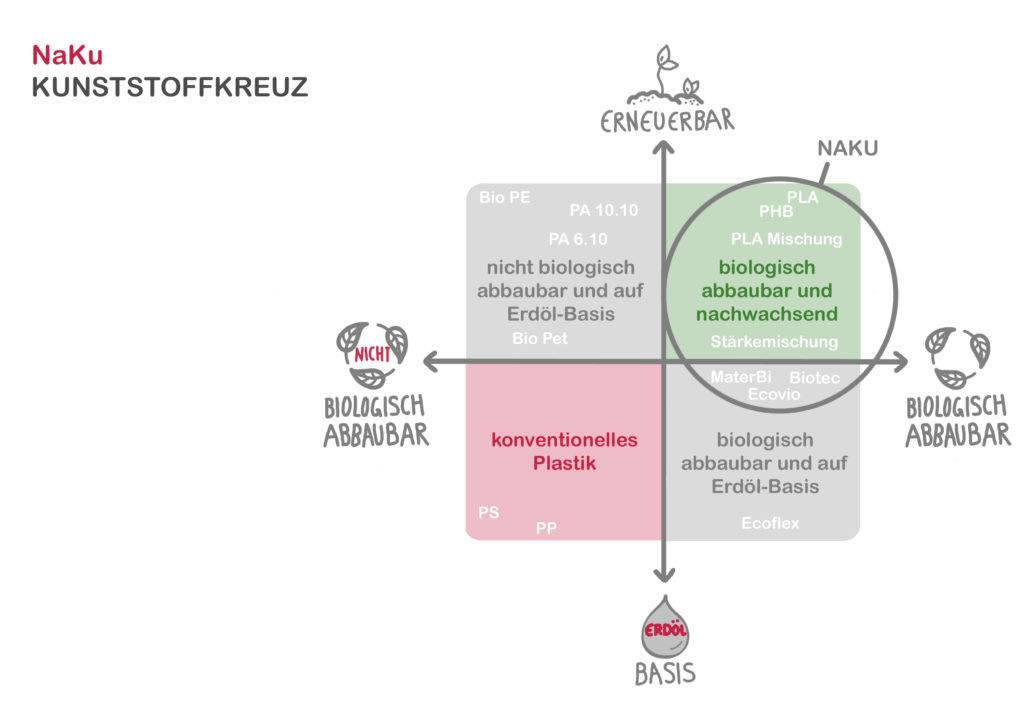
Natural Plastic (NaKu) – bioplastic combines both requirements. NaKu products are made exclusively from renewable raw materials or fully biodegradable materials AND are biodegradable.
Modern technology enables the production of various bioplastics. These consist of plants from local agriculture such as potatoes, corn or grain. Bio-based plastics obtained in this way are very similar to conventional materials. They can be processed with the same technologies and machines.
The crucial difference, however, is that if our natural plastic/bioplastic is exposed to a combination of sun, moisture, and bacteria for an extended period, it will completely decompose. This means that NaKu bioplastic products can be disposed of with household waste or composted after use. Nevertheless, even our 100% biodegradable products should not be simply thrown away carelessly. This way, waste stays with the generation that created it!
NaKu has set itself the goal of using this environmentally friendly and resource-saving technology of bioplastics in order to create everyday products of a high development standard. Natural plastic can therefore be used by everyone.
Applications:
Natural plastics and bioplastics find a wide range of industrial applications due to their good degradability and high biocompatibility. They are particularly well-suited for everyday products with shorter service lives.
The use of natural plastics ranges from bottles, shopping bags, films, cups, party tableware, disposable products, hygiene items, self-dissolving sutures, fruit, vegetable and bread packaging to children's and baby equipment.
FAQ - Frequently Asked Questions
Are there differences between bioplastics?
The term bioplastic can be very broadly defined. NaKu defines natural plastic as products based on renewable raw materials such as corn or potatoes and which are also biodegradable . Most other bioplastics often only meet one of these criteria.
How is it ensured that NaKu products are environmentally friendly?
The products are made from natural raw materials. After use, they can completely decompose if exposed to moisture, sun, and bacteria over an extended period. This makes them biodegradable.
For which products is NaKu's natural plastic used?
The areas of application are very diverse. NaKu uses the natural plastic for the production of everyday products such as bottles, shopping bags, and food packaging.