Green Events: How to achieve the transformation with organic plant-based products
The material revolution: The path to genuine green events through plant-based raw materials
Whether large-scale events like festivals, sporting events (football, running, motorsports), trade fairs, or corporate events – the events industry bears an enormous responsibility for climate and resource protection. The path to green events leads through the consistent replacement of fossil materials with innovative solutions made from plant-based raw materials.
Here we highlight the most critical areas where event organizers can take immediate action:
Holistic resource management and catering
Beyond the product selection, which we will discuss in more detail later, event organizers must ensure the entire event concept is sustainable:
- Catering packaging: Replace conventional ones Packaging and various products in catering and goods distribution through the plant-based alternatives, which avoid fossil materials.
- Culinary: Sit up regional, seasonal and plant-based food, in order to reduce transport distances and CO₂ emissions.
- Infrastructure: Use Green electricity and promote the arrival of participants with the Public transport – the biggest lever for CO₂ reduction.
- Waste separation: Run clear, well-signposted waste disposal stations one, in order to ensure the disposal of waste by type.
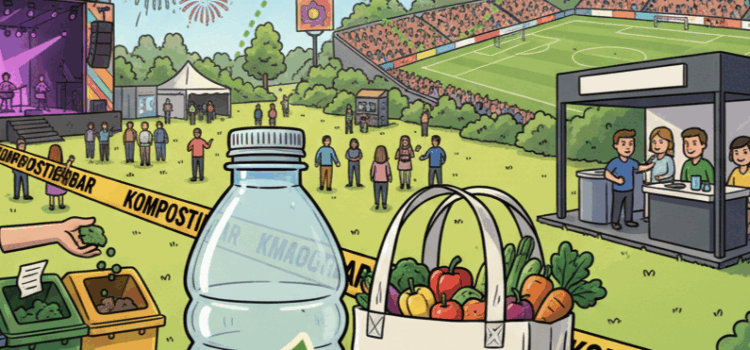
By consistently choosing alternative products made from plant-based raw materials, such as sugar bottles , biodegradable carrier bags , and barrier tapes , event organizers across all sectors – from trade fairs to football stadiums – are demonstrating a clear commitment to environmental protection and actively shaping the future of green events . We will now discuss these product alternatives in detail.
Product solutions made from renewable, compostable raw materials as an alternative for green events
Barriers and markings: Bioplastic for temporary safety
Barrier tapes are indispensable at racetracks, sporting events or for visitor management at festivals and trade fairs, but are often only used once and, if parts of them are not collected, leave behind permanent microplastics in the environment.
- The problem: Conventional barrier tapes do not decompose and break down over decades into tiny, environmentally harmful plastic particles.
- The solution – barrier tape made from bioplastic: These tapes are based on renewable raw materials (e.g. starch-based) and comply with DIN EN 13432 compostable.
- The environmental advantages of barrier tapes made from bioplastics: They offer the same tear resistance and weather resistance, but should a strap accidentally be left in nature, It leaves no permanent microplastic residue.This is an essential contribution to environmental protection, especially on large sports or festival grounds.
Revolution in the beverage sector: The sugar bottle
Beverage packaging represents a significant amount of waste at large events. While reusable packaging is the ideal solution, there is a revolutionary, sustainable alternative to the conventional PET bottle in the single-use sector: the sugar bottle.
- The difference: Conventional PET bottles are entirely petroleum-based. The sugar bottle, on the other hand, is made from bioplastic (PLA/rPLA), which is derived from... renewable raw materials – sugar – is obtained.
- The environmental benefit: During production fossil resources were conserved. and CO₂ footprint significantly compared to petroleum-based bottles reduced.
- Your solution for events: Suppliers like Naku manufacture such innovative bottles. By choosing the sugar bottle Organizers are sending a strong signal and offering a more environmentally friendly option for water and other cold drinks.
The environmentally friendly solution for goodie bags and giveaways: Organic bag instead of paper and cotton
Providing carrier bags for giveaways, merchandise, or purchases is common practice at all kinds of events – whether trade fairs, festivals, or sporting events. However, the choice of material for these bags has a significant impact on an event's environmental footprint. Instead of relying on conventional solutions like paper bags or cotton bags, biodegradable carrier bags, also known as bio-bags , offer a significantly more environmentally friendly and practical alternative.
Paper bags, although often perceived as environmentally friendly, consume a lot of water and energy during their production. They are also less tear-resistant and susceptible to moisture, which severely limits their functionality at many outdoor events or in rain showers. Cotton bags, on the other hand, have extremely high CO₂ emissions and water consumption during conventional production. They only achieve their ecological superiority over plastic bags if they are used more than a hundred times – a scenario that rarely occurs with event giveaways or spontaneous purchases.
This is where biodegradable carrier bags (bio-bags) shine : They are based on plant-based, renewable raw materials , reducing their dependence on fossil fuels. These bio-bags are lightweight, robust, and, above all, moisture-resistant, making them significantly better suited to the practical demands of everyday event use than paper bags. However, the decisive advantage in terms of sustainability lies in their compostability . This means that the materials are biodegradable according to DIN 13432. Even if a bio-bag accidentally ends up in nature, it decomposes completely, unlike conventional petroleum-based plastics, and leaves no lasting microplastics behind . They thus represent a practical and environmentally friendly single-use alternative that makes a real contribution to reducing environmental pollution. Some biodegradable carrier bags can also be used as compostable waste bags.
Conclusion: The easy way to truly green events
The transition to more sustainable events may seem complex at first glance, but the reality is: it has never been easier to opt for environmentally friendly alternatives. Plant-based plastic technologies are mature and offer practical and high-performance solutions for numerous applications where fossil-based plastics have previously dominated.
Whether it's sugar bottles for drinks, biodegradable bags for giveaways, or compostable barrier tapes for safety – high-quality, sustainable alternatives already exist for many single-use products. And the development continues: Bioplastic solutions are already available for membership cards, ID cards, and accreditations , replacing PVC and thus minimizing the ecological footprint of these often short-lived products.
Event organizers have the choice to not only reduce their own ecological footprint through conscious decisions, but also to send a strong signal to the industry and society. The shift towards green events is an investment in the future – and with the availability of products made from plant-based raw materials, this step is easier than ever.
FAQ – Frequently Asked Questions about Green Events
What exactly is meant by a "Green Event"?
A "green event" is an event (trade fair, festival, sporting event, etc.) that is planned, organized, and conducted according to sustainability criteria . This includes ecological aspects (waste prevention, resource and energy efficiency), economic aspects (regional value creation), and social aspects (accessibility, fair working conditions).
What is the main difference between plant-based plastics (bioplastics) and conventional plastics?
The main difference lies in the origin: Conventional plastics (e.g., PE, PET) are made from fossil raw materials (petroleum). Plant-based plastics, on the other hand, are produced from renewable raw materials (e.g., sugar cane, cornstarch). This conserves fossil resources and reduces the CO₂ footprint of production.
Are organic carrier bags (bio bags) automatically better than cotton or paper bags?
For single use at events, biodegradable bags made from plant-based, compostable raw materials are often the most environmentally friendly choice. Paper bags are susceptible to moisture and resource-intensive to produce. Cotton bags need to be reused very often (over 100 times) to offset their high CO₂ and water footprint. Biodegradable bags are robust and decompose when composted, without leaving behind permanent microplastics.
Can barrier tapes made from bioplastic really decompose in nature?
Yes, barrier tapes certified according to DIN EN 13432 are industrially compostable . Unlike conventional barrier tapes, which break down into microplastics over decades, these tapes decompose completely. This is particularly important in large areas such as sports fields or festival grounds, where material loss is more likely.
Is switching to plant-based products enough to call my event "Green"?
No. Choosing sustainable products is an important and visible component, but only one part of a green event . Additional measures include reducing travel emissions (promoting public transport), using green electricity , a consistent waste separation concept , and prioritizing regional, vegetarian/vegan catering.
Are products made from plant-based raw materials more expensive than conventional plastic products?
Acquisition costs may be slightly higher in individual cases. However, the overall costs of an event can often be offset or even reduced by choosing sustainable products.
What alternatives are there to PVC cards for accreditations or membership cards?
Instead of PVC, which is difficult to recycle and problematic, cards are now made from bioplastics (often PLA-based or other plant-based polymers). These offer the same durability and print quality as PVC, but are a significantly more resource-efficient alternative for temporary or short-lived event badges.
Where can I find a wide range of sustainable products for my event?
A good starting point is specialized suppliers like Naku, who offer a dedicated product range made from plant-based, renewable raw materials to directly meet the needs of event organizers.
Request a quote or contact us now