Fraud with organic bags: How to protect yourself from counterfeits!
Further information: Deception regarding organic waste bags (Update 2025)
The demand for environmentally friendly packaging is rising, but unfortunately, so is the number of counterfeit products. Biodegradable bags are meant to be a genuine alternative – but only if they deliver on their promises! As a long-standing manufacturer of biodegradable bags, carrier bags, and films, we are committed to providing you with comprehensive information about counterfeit products and offering practical tips on how to protect yourself.
What makes counterfeit organic bags so dangerous?
The damage caused by counterfeit bags is far-reaching and affects the entire value chain. Above all, it severely undermines trust in genuine bioplastics.
Danger to compost and the environment:
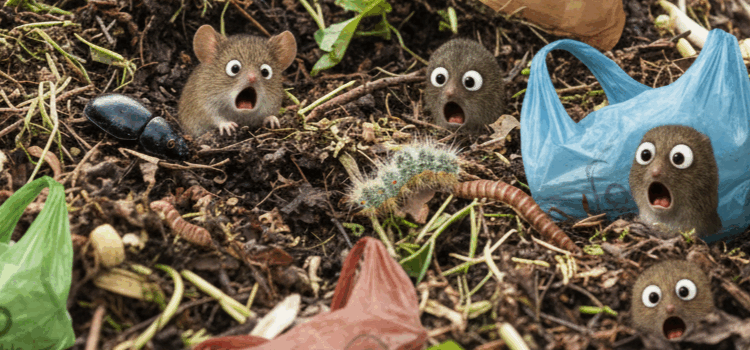
Many people, in good faith, dispose of organic waste in what they believe to be a compostable bag. However, if this bag is counterfeit (often made from conventional petroleum-based plastic), it will not decompose in industrial composting facilities.
The result: Microplastic particles are formed in the finished compost. These then enter fields and gardens via the compost, and thus our soils and the food chain. The end product is contaminated and the organic waste recycling system is jeopardized.
Misleading and deceptive:
End consumers believe they are doing something good for the environment, but unknowingly use conventional plastic.
Distortion of competition:
Honest manufacturers who rely on renewable raw materials and invest in quality are unfairly disadvantaged by unfair price competition.
Here's how to protect yourself against fraud
Since counterfeiters not only advertise their products as biodegradable bags with imprints like "biodegradable," "Bio," "Biobag," etc., but also copy official logos and symbols, you must pay close attention to the legitimacy of your supplier. Keep in mind that as a business (e.g., in retail or commerce), you can also be held liable if you distribute counterfeit biodegradable bags.
Beware of counterfeit logos: Be careful, as even official certification logos or other compostability symbols are deceptively printed on counterfeit bags. In some cases, even printed EAN codes, intended as proof of origin, are not traceable.
Buying from local, transparent manufacturers: The safest option is to buy directly from established, local manufacturers . Where there is a transparent website, legal notice, and clear contact information, you can ask questions directly if you have any doubts.
Tips for end consumers and businesses/trades
Pay attention to price and feel : The production of compostable material based on renewable resources is more expensive than that of conventional petroleum-based plastic. An extremely low price is often an indication of a counterfeit. Genuine biodegradable bags also feel softer and more supple and don't rustle as loudly when handled.
Video test: Watch our video series further down this page to see how you can identify counterfeit bags with three simple tests.
Why not just paper?
| Challenge | Problem with paper bags | Solution through biodegradable bags |
| Wetness & Stability | Moisture quickly softens the paper, creating a risk of tearing and leakage. | High tear and wet strength, hygienic barrier. |
| Food contact | Recycled paper is often contaminated with paint residues or other substances and is not suitable for direct contact with open food. | Material made from renewable resources, approved for food contact and safe. |
| Organic waste disposal | Paper often decomposes more slowly than organic waste in industrial composting. | Specifically designed for the disposal of organic waste* (DIN EN 13432), guarantees rapid decomposition without residue. |
* Please observe the regulations of the local waste collector!
Organic carrier bags in detail: Insights into production & how to identify counterfeit organic bags
A look into the production of biodegradable bags and films
Identifying counterfeit organic bags – an overview
rustling test
Swimming test
Burning test
FAQ – Frequently Asked Questions about Counterfeit Organic Bags
What is the biggest problem with counterfeit organic produce bags?
The biggest problem is the contamination of the compost: If counterfeit bags are disposed of in the organic waste, microplastic particles are created in the composting plants, which then enter the soil and the food chain via the compost.
How can I, as an end consumer, recognize a counterfeit organic produce bag?
Be suspicious of extremely low prices. Pay attention to the feel (genuine bags feel soft and velvety) and check the reliability of the source (local manufacturer with transparent communication).
Are official compost logos being faked?
Yes, counterfeiters print even official and protected logos deceptively realistically on the bags; logos alone are therefore not sufficient proof of authenticity.
What is a strong warning sign when buying organic bags?
An extremely low or unbeatable price is a clear warning sign. The raw material costs for certified, compostable material are higher than those for conventional petroleum-based plastics.
Where can I get the safest organic waste bags?
Buy directly from long-established, local manufacturers (like Naku) with transparent communication, a clear website and contact options.
What happens if I (even unknowingly) give out counterfeit organic bags to my customers?
You risk unknowingly misleading your customers, damaging trust in environmentally friendly packaging, and indirectly contributing to the spread of microplastics in the environment.
Why shouldn't I simply use paper bags instead of biodegradable bags for groceries?
Paper bags often have problems with moisture and stability. Furthermore, recycled paper is often contaminated with printing inks or other substances and is therefore not suitable for direct contact with unpackaged food.
Request a quote or contact us now